Samuel Johnson
The Surgeon of CrowthorneSamuel Johnson made the dictionary a literary monument without pretending that it could arrest the life of a language. His achievement grew from a commercial commission, a vast but deliberately bounded reading programme, and a method that made quotations—not abstract rules—the evidence for meaning. The result was at once an audacious record of English usage and a portrait of its majesty, beauty, and confusion.
Identity and Ambition
Before Johnson, Nathaniel Bailey and other eighteenth-century lexicographers had laboured to gather the language, but their works still fell short of the comprehensive record readers wanted. The difficulty was not simply the number of words: the undertaking demanded intellectual reach, courage, sustained labour, and time. Johnson accepted the challenge that earlier makers had approached tentatively. In retrospect, his Dictionary stands out as an unparalleled triumph, and as a record of the English of his day rather than merely a list of approved forms.
The work’s physical form reinforces its scale. Its large-format volumes were heavy enough for a lectern rather than easy handling, bound in rich brown leather, with thick creamy paper and deeply impressed print. Their material weight accompanies a verbal abundance: Johnson’s definitions could be elegant and quaint, but their charm was only one part of the achievement. The Dictionary’s lasting force lay in its attempt to show how words worked across actual writing.
Commission, Patronage, and Independence
The immediate impetus came from the bookselling trade, not solely from learned debate. In 1746, five London booksellers, including the Longmans, believed a new dictionary could sell well. They approached Johnson, a parliamentary writer whom they knew to be eager for work and short of money, with an offer of fifteen hundred guineas, half payable in advance. Johnson accepted, asking only that he seek the patronage of Philip Dormer Stanhope, 4th Earl of Chesterfield, then a leading arbiter of literary reputation.
Chesterfield’s support proved far less substantial than the project required. He promised the prestige of his approval but declined to become its patron, apart from giving Johnson a draft for ten pounds. Later, when the Dictionary succeeded, Chesterfield claimed a share in the achievement. The discrepancy between the authority he could confer and the assistance he actually provided became a public grievance. Johnson’s later description of him as teaching “the morals of a whore and the manners of a dancing-master” made the breach unmistakable; Chesterfield treated the criticism as good-natured, though the account stresses that it was not.
Johnson’s undertaking was also shaped by a changing view of what a dictionary could accomplish. He may initially have intended to fix English, but the prevailing scholarly account described in the narrative is that, halfway through his six-year task, he recognised that such a goal was both impossible and undesirable. The language depended on custom and use, and therefore changed over time: what one age considered elegant could seem barbarous to another. Johnson’s achievement was not to impose permanence, but to make a sustained record while the language remained in motion.
Reading and Evidence
The scale of the language forced Johnson to set limits. He judged that English had reached a high point in the writings of William Shakespeare, Bacon, and Spenser, and saw little need to search much earlier than their era. He chose the works of Sir Philip Sidney, who died in 1586 at the age of thirty-two, as a useful starting point; the last books published by newly dead authors marked the other end. The Dictionary thus drew chiefly on roughly a century and a half of writing, with occasional material from Chaucer.
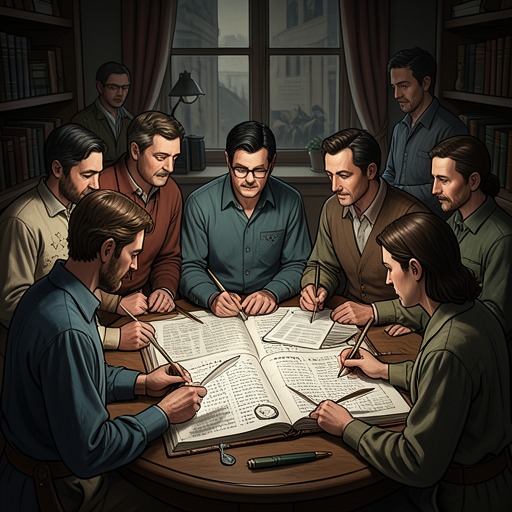
Johnson’s method turned that reading into a working archive. He read books, underlined and circled words, and annotated selected pages. He then required his assistants to copy onto slips the complete sentences that displayed the chosen words. Those slips could be filed and retrieved when a particular meaning needed illustration. The system made literary examples the basis for defining usage: a word’s senses could be distinguished through the contexts in which writers had used it, rather than reduced to a single prescription.
That approach demanded both a vast reading range and close attention to differences of sense. Johnson listed 113 transitive senses of “take” and another 21 intransitive ones, supporting them with quotations. The entries encompass taking as seizing or grasping, catching with a hook, exposing someone’s error, winning favour, proving effective, claiming or assuming a right, mounting a horse, fleeing, and removing clothing. The breadth of the entry makes ordinary words into evidence of how many actions and meanings a familiar group of letters can carry.
His treatment of other common words likewise demonstrates the method’s range. “Oats” receives a pointed definition contrasting English use as animal feed with Scottish use as human sustenance. “Lexicographer” becomes “a writer of dictionaries; a harmless drudge,” a definition at once self-deprecating and memorable. The narrative presents such wit not as a substitute for scholarship, but as part of a work able to register both the play and the complexity of English. Johnson’s nearly single-handed search for uses across his chosen corpus extended beyond striking examples to everyday words such as “set,” “do,” and “go.”
Reception, Character, and Legacy
The Dictionary attracted detractors as well as praise. Some critics dismissed it as work any schoolmaster could have done or as a glossary of Johnson’s own writing; others accused it of Tory bias or called it a vehicle for Jacobite politics. One woman objected to its omission of obscenities, prompting Johnson’s wry reply that he hoped he had not “daubed my fingers,” before observing that she had been looking for them. These attacks reveal how the Dictionary could be judged not only as scholarship but as a political and moral intervention.
Its admirers placed it on a broader European stage. Voltaire proposed that the French model a new dictionary on Johnson’s, and the Accademia della Crusca praised the work as a lasting monument to its author, an honour to his country, and a benefit to European letters. A later assessment called Johnson’s contribution “primus inter pares”; Robert Burchfield, editor of the four-volume Oxford English Dictionary supplement of the 1970s, singled it out as the only dictionary in the English literary tradition compiled by a writer of the first rank.
Johnson remained, in the account, calmly modest under both criticism and acclaim. He was proud of what he had done, yet conscious of the grandeur of the language he had undertaken to describe. The Dictionary became his monument in common speech: James Murray later observed that when people said “the Dictionary,” as they might say “the Bible” or “the Prayer-Book,” they meant Johnson’s work. But Johnson’s own preface turned attention beyond the maker and the book. He wrote, “words are the daughters of earth, and that things are the sons of heaven.” His life had been devoted to gathering words; the phrase reserves a deeper significance for the things they name, and for the world no dictionary can claim to fix.